Exciting new announcement!

For many years, our work has centered on a simple idea: specialized knowledge becomes much more accessible when it is paired with clear explanations, structured study tools, and publishing infrastructure that respects the reader’s time.

We started in amateur radio, and that remains an important part of what we do. But once you build durable systems for learning, review, publishing, and question-based study, it becomes difficult not to notice how portable those systems are. We have wanted to talk about this for a while, and it is satisfying to finally say it out loud.

Today, we’re launching:

  • YamStudy.org — a study platform for people who would like a more structured relationship with yams
  • YamBook.org — a book project focused on the science, cultivation, handling, history, and culture of the true yam. Available online (html, PDF, and audiobook format) for free, or Buy it in Paperback from Amazon!

Why yams?

This is a fair question. The answer begins with naming. We already live in a world of HamStudy and HamBook, alongside Signal Stick, Signal Staff, and other products that benefit from a certain amount of family resemblance. Once you accept that naming continuity is part of the infrastructure, the step from Ham to Yam starts to look less random and more like a disciplined adjacent-domain extension.

That logic only works because the subject itself is worth caring about. Yams are globally significant, culturally important, frequently misunderstood, and routinely confused with things that are not, in fact, yams. That is exactly the kind of knowledge gap we tend to notice.

Why us?

We already had most of the necessary infrastructure, and we were unusually well positioned to use it. Our existing study platform, publishing workflow, import pipeline, and static-site tooling were all built to be largely content-agnostic. They care much less about whether the subject is radio, regulation, propagation, taxonomy, storage, or tuber morphology than one might expect.

That meant we could expand into a neighboring subject with unusually low friction, which is the kind of sentence every organization hopes it will someday get to say without embarrassment:

  • the name was familiar enough to make immediate sense internally
  • the domains were available
  • the logo adaptation cost was acceptably low
  • the publishing pipeline was already in place
  • and our operational tolerance for niche topics was, by this point, well established

At a practical level, moving from HamStudy to YamStudy is simply a very efficient use of existing letters. It also meant we did not need to teach ourselves an entirely new product family just to support another niche subject.

What we’re launching

YamStudy

YamStudy is the interactive side of the project.

It is designed around the same core principle that has guided our other study tools: break a specialized subject into manageable pieces, make it easier to review, and reduce the amount of time users spend trying to assemble a coherent path for themselves.

The yam space has waited long enough for a more disciplined approach, and we are glad to finally be in a position to offer one. While we did have to create the question pool ourselves to make this happen, we are confident that the infrastructure to administer those exams will eventually follow from other industry leaders.

YamBook

YamBook is the long-form companion resource.

It covers the true yam from multiple angles, including:

  • classification and identification
  • growth and propagation
  • cultivation and field management
  • harvesting, curing, and storage
  • food preparation and kitchen use
  • history, trade, and cultural significance

Not every important body of knowledge receives the book infrastructure it deserves. We are correcting that, one root vegetable at a time, and we have been looking forward to using that sentence for longer than is probably healthy.

Alternatives considered

As part of this process, we did evaluate other adjacent expansions.

Most notably, we spent time considering a more literal interpretation of “HamStudy.” While there is a certain surface logic to a pork-oriented educational initiative, we ultimately concluded that such a move would introduce unacceptable brand ambiguity. Much as we wanted to introduce an entirely new Ham Study, and as a public service the question pool remains on the yamstudy.org website, we abandoned the project for practical reasons: where misunderstanding is unavoidable, it’s best to be misunderstood for new reasons instead of reinforcing the old ones.

In the end, Yams presented a clearer strategic lane, a better linguistic fit, and a much smoother continuation of our existing naming habits.

It is also worth noting that YamStudy already includes a Study Ham question pool, which we believe demonstrates both conceptual flexibility and a healthy respect for continuity.

Why this fits our broader mission

We have always believed that communities are better served when useful knowledge is easier to access, easier to navigate, and easier to keep around.

Sometimes that means exam prep.

Sometimes it means books.

Sometimes it means taking a level of organizational seriousness that was originally developed for one obscure domain and applying it to another obscure domain with complete confidence.

We do not see this as a departure from our mission. We see it as the same study-and-publishing machinery applied to another niche subject, with the naming system helping more than usual.

Or, to put it more simply: once you have built a good system for helping people study specialized things, it is only responsible to keep finding specialized things.

A call to the broader yam industry

We do not view this as a category we should occupy alone.

One of the best things about entering a new niche this early is the chance to help establish a healthier surrounding ecosystem. We would be delighted to see other organizations, publishers, platform builders, exam administrators, extension specialists, curriculum designers, and serious yam-adjacent professionals bring their own expertise into this space.

There is no reason modern yam education should stop with two projects.

We hope it does not.

We would love to someday see a wider family of tools emerge around this category, including the kinds of offerings that serious observers of the study-tool ecosystem might already be expecting: Yam Raising Prep, YamTestOnline, YamExam.org, Yam Rotation Crash Course (YRCC), and Fast Track to Your Yam License. More, we hope to see new exciting initiatives, like Yam It Up! and perhaps a new American Yam Yield Leauge (AYYL). Perhaps we’ll even see exciting new agricultural conventions, such as a YamVention or even YamCation. The possibilities are endless, and we are thrilled to be the first in this exciting new space!

If our contribution to the yam space is partly to make other people say, “I guess we should probably build that too,” we will consider that a meaningful success.

Learn more

Both projects are now live, and we are genuinely delighted to be able to say that out loud:

We want to bring the same level of seriousness, structure, and calm operational commitment to yams that our users have come to expect from us elsewhere.

More importantly, this finally exists in public. We have spent enough time looking at these names, these pages, and this increasingly defensible line of reasoning in private. It is a relief to bring them into the world.

The infrastructure is the same… The crop is new.
Posted in Uncategorized | 1 Comment

The 2026 US Technician Question Pool is Here!

The first release of the 2026 Element 2 (Technician class) question pool is out, and you can find it here: https://ncvec.org/index.php/2026-2030-technician-question-pool

As hopefully everyone knows, the question pool is not maintained by the FCC—it’s maintained by the Question Pool Committee (QPC), which is part of the NCVEC. It’s not uncommon for the QPC to catch a few typos or even change a few questions after the initial release, so things may shift a little more before July 1, 2026, which is when this new pool takes effect.

If you’re studying now and plan to test before July 1, 2026, you’ll still be tested on the current 2022-2026 pool. The new pool only applies to exams administered on or after that date.

What Changed?

You can find a graphical “diff” of the changes here: https://hamstudy.org/diff/E2_2022/E2_2026

Here is a more text-oriented output from the same system: https://gist.github.com/taxilian/c6fca675a58fd4b165e97b3334fc8f66

Here’s a quick breakdown:

  • 26 new questions added
  • 29 questions removed
  • 69 questions with changed wording
  • 8 questions moved to different IDs (same content, new number)

The New Stuff

The new questions cover some topics that weren’t previously in the Technician pool:

  • Licensing details: How you receive your license (email from the FCC), when you can renew (90 days before expiration)
  • Digital modes: More emphasis on DMR (code plugs, color codes), Winlink for emergency email, and FT8 privileges for Technicians
  • Station control: Clearer definitions of control operators, remote control, and auxiliary stations
  • Propagation beacons: Where to find HF beacons on 10 meters (28.200-28.300 MHz)
  • Practical knowledge: How ohmmeters work, VFO function, foam vs solid dielectric coax, weatherproofing connectors

Wording Updates

Many of the “changed” questions are minor cleanup—adding hyphens to “2-meter” instead of “2 meter,” spelling out abbreviations like DTMF and CTCSS, or rewording questions slightly for clarity. A few notable wording changes worth mentioning:

  • The ionosphere question now says “reflect” instead of “refract or bend” (same concept, different terminology—and yes, hams will argue about which is more correct)
  • Auroral backscatter is now described as having a “raspy sound” rather than “varying signal strength”
  • FT8 setup now references generic “FT8 software” instead of specifically naming WSJT-X
  • The dummy load answer now explicitly includes “50-ohm” in the description

What Got Removed?

Some questions that were removed include the 219-220 MHz segment restrictions, the definition of a beacon (replaced with a question about where to find them), and a few that were consolidated or replaced with updated versions.

Study Resources

We’ve already got you covered:

  • Study the 2026 pool on HamStudy — All questions are available with full explanations, even the new ones. We haven’t linked it from the front page yet since there’s still six months before it takes effect, but it’s ready when you are.
  • 2026 Technician HamBook — The new edition is already in draft form, fully updated for the 2026 pool. It may see some refinements before the official release, but the content is there.
  • 2022 HamBook Supplement — If you’ve been studying the current HamBook and want to know what’s new, we’ve added a supplemental chapter covering all the new material in the 2026 pool.

The Bottom Line

If you’re planning to get your Technician license, don’t stress about which pool you’ll be tested on—the fundamentals are the same. The 2026 pool modernizes some questions around digital modes and clarifies a few regulatory details, but it’s not a dramatic overhaul. Study the material, understand the concepts, and you’ll do fine on either version.

Questions? Drop us a line or join the conversation in the comments!

73, The HamStudy Team

Posted in Uncategorized | 4 Comments

SignalStuff 2025 Black Friday Sale!

The SignalStuff 2025 Black Friday sale is running now (Fri Nov 28, 2025) through the end of day Monday (Dec 1, 2025)! This is the only time all year that Super-Elastic Signal Sticks are on sale, so act fast!

Read more here…

Posted in Uncategorized | Leave a comment

SignalStuff Black Friday Sale

The SignalStuff Black Friday sale is live now through the end of day (MST) Monday Dec 2! 10-20% off nearly all products. Plus, check out the new Signal Strand™ system to get the most out of your Signal Stick™!

Posted in Uncategorized | Leave a comment

Announcing HamStudy Mobile 2.0!

For longer than we care to admit, we’ve been working on a complete rewrite of the HamStudy.org mobile apps. The work has finally paid off, and we’re excited to announce new versions of the mobile app now available on the App Store and Google Play!

Knowing a number of our Android users have run into problems over the last couple years, we put a heavy focus on app stability, with overwhelmingly positive feedback so far. In addition to stability and general look-and-feel improvements, be on the look out for these additional features:

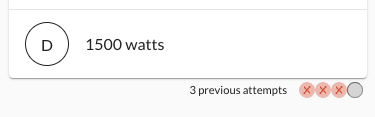
  • Understand your progress better and remove the mystery around the questions you’re asked by seeing your study history on each question while studying.
  • Multiple learners can now work on the same device, each with their own progress and HamStudy.org account syncing.
  • Zoom in on diagrams to view in full screen, or pinch to zoom in even further. No more squinting at tiny images on tiny screens.
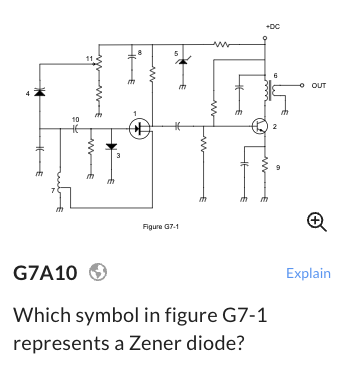
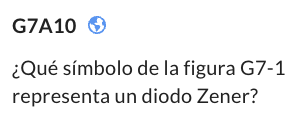
  • Improved foreign language support means you can now study for your US amateur radio license in Spanish. Toggle for individual cards, or set Spanish as your default in account preferences.
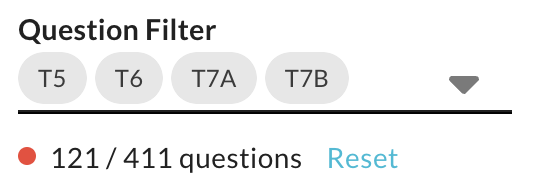
  • Custom question filters are easier than ever, allowing you to quickly mix specific subelements and sections however you want to create a custom study experience tailored to only what you want to study.

One more major feature deserves to be highlighted. We know that HamStudy.org is just one of many tools people use when preparing to get licensed. People often approach us saying “I used your app while reading […],” and proceed to share success stories of how they used HamStudy and this or that book or video series together.

We’ve made this easier than ever in the new HamStudy.org mobile app.

Follow along with your license manual

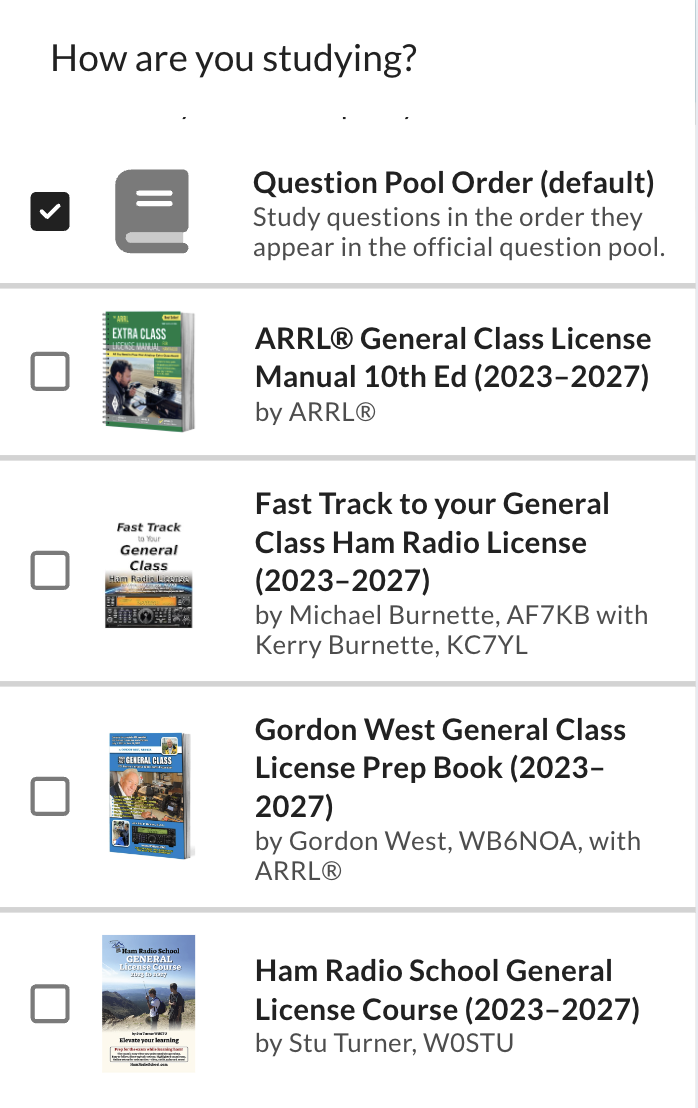
Once you select a license class to study, you now have the option to select a book you’re studying with. Selecting a book rearranges how questions are organized throughout all parts of the application:

  • Inside the Read Questions area of the app, you’ll see a list of chapters instead of subelements.
  • When you’re Studying, maybe you just finished reading part of the book and want to drill yourself. Using the question filter, you can instantly choose to study just Chapter 4 and Chapter 5 instead of figuring out which questions to look at on your own.
  • After taking a Practice Exam, instead of being told your weak area is “Subelement T6,” you’ll instead be told to work on your understanding of Chapter 3.

This is all possible thanks to the collaboration and permission of our friends at Fast Track Ham, Ham Radio School, ARRL, and Gordon West. If you’re not yet sure which books to use as you study—whether you’re new to the hobby, or finally looking to get that next upgrade—check out what each of these great teams has to offer. You’re sure to find something you like!

73,

The HamStudy.org team

Posted in Uncategorized | 9 Comments

Signal Stuff 2023 Black Friday sale!

The sale is over; it ran Nov 24, 2023 through Nov 28, 2023. You can still find great products that support HamStudy and ExamTools at https://signalstuff.com !

Thanks for your support!

Posted in Uncategorized | 1 Comment

A Year in Review

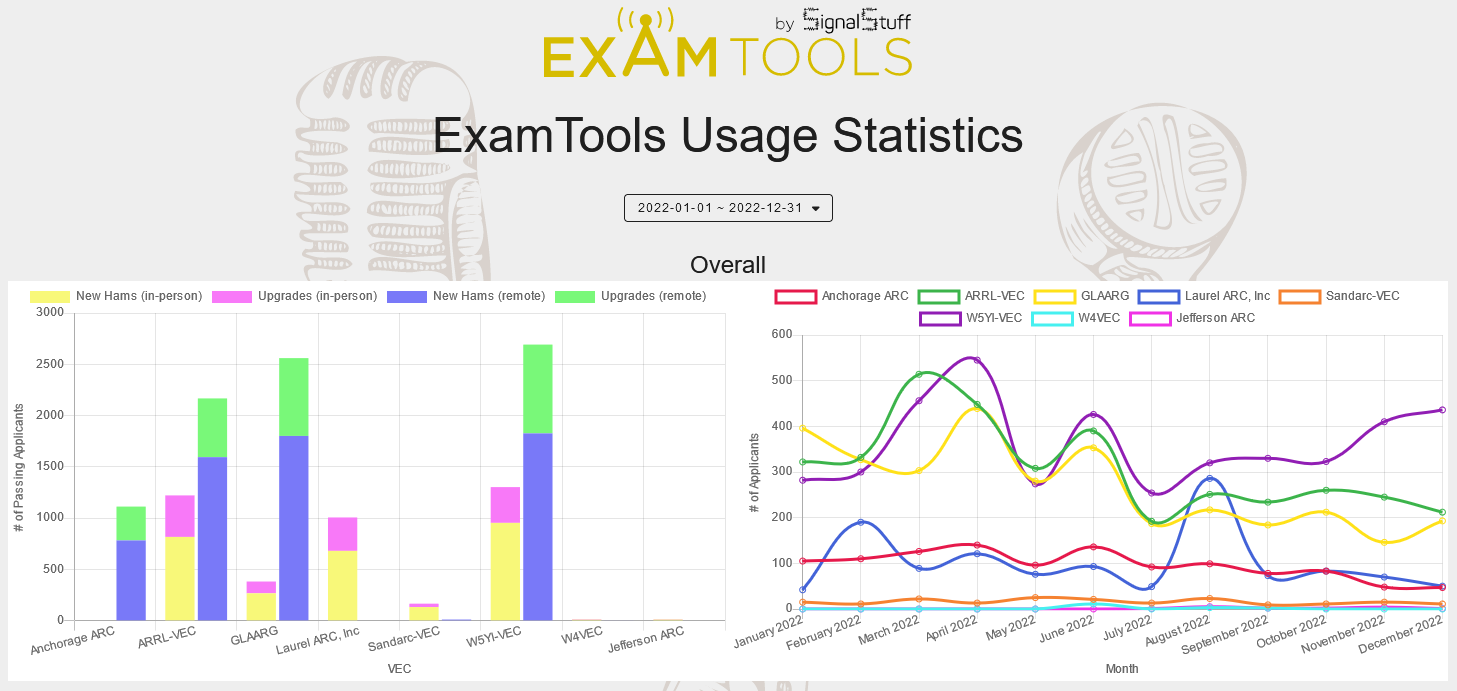
With 2022 in the books, we thought it’d be nice to see the impact that ExamTools has had on the overall amateur radio community. While the ExamTools software has been around for well over a decade, its usage picked up strongly during the pandemic in 2020 with optimizations that were made to support different exam formats and, importantly, digital paperwork and signatures. In the first year of the pandemic, ExamTools was used for roughly 20% of all amateur radio licenses granted by the FCC in that time frame (see earlier blog post from 2021).

In 2022, ExamTools adoption continued to grow, with more VECs coming onboard and using the system for both in-person and fully-remote exams. Many teams that were on-hold during the pandemic are restarting in-person exam sessions and realizing how much ExamTools helps them administer exams. We now have 8 VECs using the software including W5YI, ARRL, GLAARG, Anchorage, Laurel, SANDARC, Jefferson, and W4VEC. These VECs realize the tremendous value of using ExamTools to not only streamline their exam administration, but also the submission process for their exam teams and the FCC database. Teams using ExamTools love how all the paperwork is now electronic, including application registration, notification, and signatures. Sessions that used to take hours to process can now be completed and fully submitted to the VEC in minutes. It’s truly a game changer for volunteer examiners, their VECs, and the applicants who all benefit from faster and more accurate processing of their exam sessions.

Many people don’t realize that using ExamTools doesn’t automatically mean giving exams on a computer or tablet. In fact, ExamTools supports a variety of exam formats including existing VEC’s paper exams, GradeCam paper exams, tablet/phone/laptop computer-based exams, and fully-remote exams using software like Zoom. GradeCam is a exam-grading technology that is incredibly powerful for exam teams and so easy to learn. It uses the camera in your laptop, cell phone, or tablet to quickly and accurately grade the applicants’ bubble answer sheet at your session. For many teams where using paper exams is the right choice for them, GradeCam offers a fantastic way to modernize and optimize their exam process, freeing up precious volunteer time to interact with the applicants and not waste time manually grading exams multiple times.

To celebrate the year, let’s take a look at some of the numbers from 2022 compared to 2021.

  • Total number of In-Person Exams administered using ExamTools
    • 2021: 2536 in-person exams
    • 2022: 4103 in-person exams
    • That’s a 62% increase for in-person exams!
  • Total number of Remote Exams administered using ExamTools
    • 2021: 11034 remote exams
    • 2022: 8542 remote exams
    • That’s a 23% decrease for remote exams
  • Total number of exams administered using ExamTools
    • 2021: 13570 exams
    • 2022: 12645 exams
    • That’s a 7% decrease in the total number of exams

And now for some fun VEC awards for the 2022 Honor Roll:

  • Most Overall Exams Award:
    • W5YI VEC with 3994 exams administered in 2022!
    • W5YI VEC also wins the award for Most In-Person Exams AND Most Remote Exams for 2022!
  • Biggest Overall Exam Growth Award:
    • SANDARC VEC for 169% year-over-year growth from 2021 to 2022. We’re glad to have you on the ExamTools team and look forward to more exams in 2023!
  • Biggest In-Person Exam Growth Award:
    • GLAARG VEC for 515% year-over-year growth from 2021 to 2022 for their in-person exams!

To look at the data yourself, feel free to check out the awesome Stats Page that Richard KD7BBC created!

It’s always a good time to remind folks that ExamTools is offered at no cost to VE Teams. In fact, ExamTools is funded entirely by donations and with proceeds from HamStudy.org and SignalStuff.com. Signal Stuff makes the Super Elastic Signal Stick antenna that is a popular high-gain antenna for handheld radios and has been breaking sales records again this past year. ExamTools is also supported by a number of illustrious volunteers that are online day and night to help provide tech support, approve accounts, and answer questions for any teams using ExamTools. These Experience Support Volunteers include: Nick N1CCK, Mitch N2YIC, Grant W4KEK, Jason WX2Q, and Marcel AI6MS. Additionally, there is an online Discord server with over 1000 verified volunteer examiners from across the globe engaging in discussions and helping each other out to deliver the best examination experiences for the new and upgrading hams we support.

Thank you to all the Volunteer Examiners that make amateur radio continue to grow every year! Here’s to celebrating a successful 2022 and for an even better 2023! 73!

Graphs of the overall ExamTools usage statistics for 2022
Posted in Licensing, News | Tagged , , , , , | 2 Comments

Signal Stuff Sale!

SignalStuff is now running their “I can’t believe we missed Black Friday!” sale! Check out the details here! Begins Dec 2, 2022 and runs through Dec 6, 2022.

Sales on SignalStuff.com directly support all HamStudy and ExamTools development. Thanks for your support!

Posted in Uncategorized | 2 Comments

Why should I use HamStudy’s Study Mode and not just take practice exams?

We get this question a lot. People often wonder why they can’t just take practice exams to learn the material. In theory, you can do this, but let’s take a look at the numbers! We ran 10,000 simulations of randomly-generated practice exams for each exam’s question pool, and then calculated the number of practice exams one would need to take to see every single question at least once. Note that is just to see every question, this doesn’t mean you’ve actually learned it. Here’s what we found:

For the 2022 Technician Question Pool:

  • Mean: 76.1073 exams
  • Median: 71 exams
  • Mode: 68 exams
  • Max: 184 exams
  • Min: 44 exams

For the 2019 General Question Pool:

  • Mean: 91.5207 exams
  • Median: 77 exams
  • Mode: 82 exams
  • Max: 246 exams
  • Min: 53 exam

For the 2020 Extra Question Pool:

  • Mean: 90.2247 exams
  • Median: 78 exams
  • Mode: 84 exams
  • Max: 210 exams
  • Min: 52 exams

As you can see, you’d need to take between 44 and 246 practice exams just to see each question at least once! Using a study method like the one we’ve designed in HamStudy’s Study Mode is a great way to get exposed to all the questions and get refreshed on questions you need to study more. Check out the HamStudy FAQ for more fun details on how the Flash Card method works and how your aptitude score is calculated: https://blog.hamstudy.org/faq/

Posted in Uncategorized | 4 Comments

Field Day is this weekend! Time for an upgrade?

Did you know that over 16 volunteer examiner teams are running sessions at the annual ARRL Field Day this weekend using ExamTools? If you’ve been studying using the HamStudy app and are ready to go, then it’s a great time to find a session to sign up with. You can find teams holding both in-person and remote exams using the handy session finder at: https://hamstudy.org/sessions/

And don’t forget, the current Technician Exam question pool expires on June 30, 2022, so if you take the exam after then, be sure to use the new question pool when you study.

If you’re not looking to test, but want to find a local field day event to participate at, then check out the Field Day Locator here: http://www.arrl.org/field-day

ARRL Field Day
Posted in Uncategorized | Leave a comment